Why Learn AI: Time Back, Better Jobs, And Staying In Charge
The short version
- Learn AI because it gives you back hours of routine work every week, starting the first week.
- Employers now expect people in ordinary roles to use AI tools well, and that expectation is growing.
- Knowing how AI works keeps you in charge: you can spot its mistakes and decide what it should and shouldn’t touch.
- Falling behind comes from never opening the tools. You don’t need to write code to keep up.
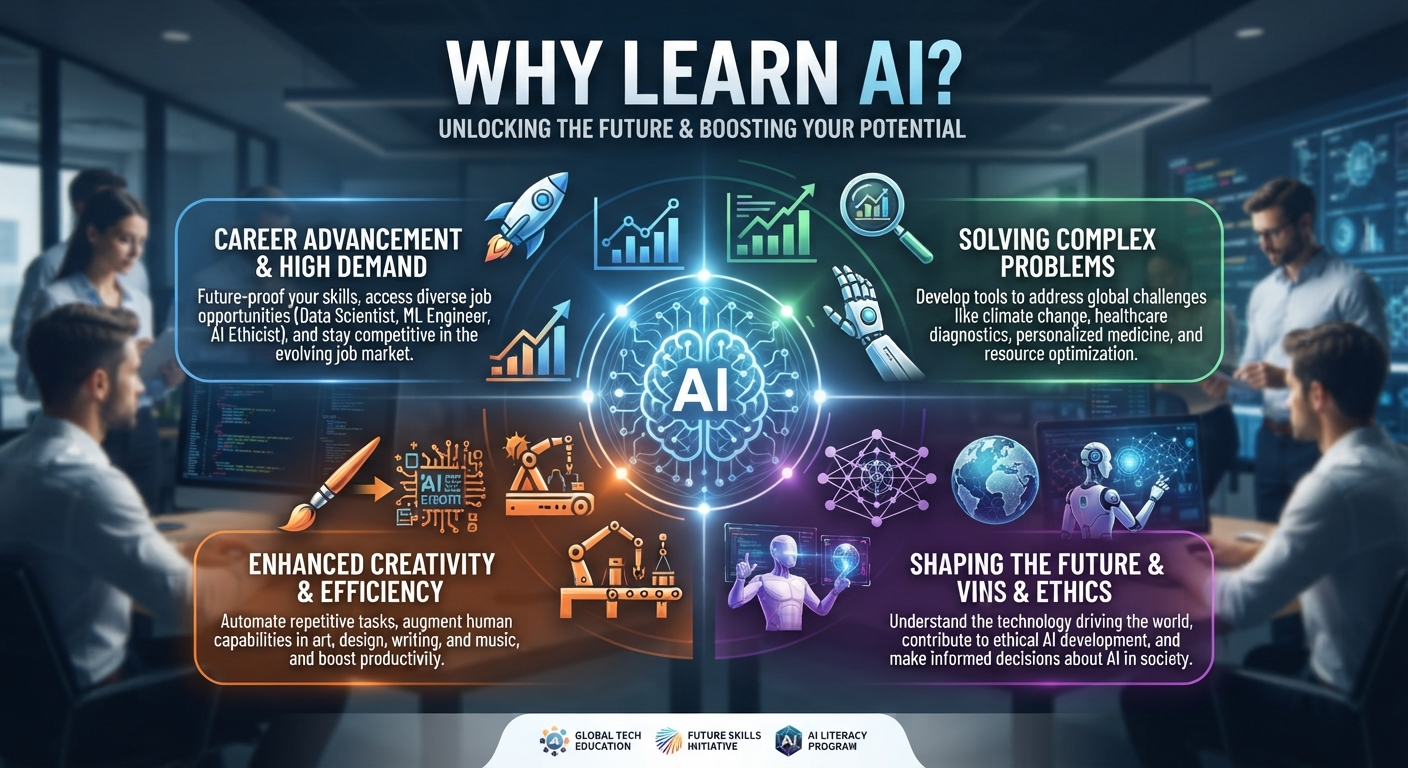
Why learn AI now, if you aren’t in tech? Because it pays you back in three ways that matter to most working adults: time, jobs, and control. You don’t have to become an expert. A few hours of practice gets you most of the benefit, and waiting only makes the gap between you and the people already using it wider.
There are plenty of people telling you AI is overhyped, and some of the hype is silly. But the everyday value is real and easy to test yourself. Here’s the case.
Reason one: it gives you your time back
The strongest reason is also the least exciting. AI is very good at the dull middle of work: first drafts, summaries, reformatting, sorting, and turning messy notes into something clean.
Picture a normal week. You write 30 emails, sit in 6 meetings, update a spreadsheet, and write one report. With AI, the report starts from your notes instead of a blank page. The meeting notes become action lists in a minute. The spreadsheet formula you’d normally search for gets written for you. The tricky email to an unhappy customer gets a calm first draft.
None of this is magic. Each task still needs your eye. But shaving 15 minutes off ten tasks a week adds up to a couple of hours, and it keeps adding up. Our guide on how to use AI at work lists the tasks to start with.
Try this today with any chat tool:
“Here are my messy notes from a meeting: [paste notes]. Turn them into a list of decisions made, a list of action items with the person responsible, and any open questions. Keep it short.”
Reason two: jobs are changing around you
You’ve probably seen AI mentioned in job postings for roles that have nothing to do with technology. Office managers, marketers, recruiters, paralegals, teachers. Employers aren’t asking these people to build AI. They’re asking them to use it.
That changes the math on your career. Two candidates with the same experience apply. One can show how they use AI to do the job faster and check its work. The other has never tried it. The hiring choice isn’t hard.
The same goes for people who run their own business. A solo bookkeeper, a contractor, a real estate agent: each is competing with people who now answer leads faster, write proposals quicker, and post more often. You don’t need to match them tool for tool. You do need to know what’s possible so you can choose. A 20-minute job like writing a quote cover letter or a listing description can become a 5-minute review, and those minutes are yours to spend on the work customers actually pay for.
Reason three: staying in control
This is the reason people skip, and it’s the one I’d put first if I had to rank them.
AI is already being used on you. It writes some of the customer service replies you get. It sorts job applications. It drafts the marketing you read. If you don’t understand how it works, you can’t tell when it’s wrong, and you can’t push back.
Learning AI teaches you a few hard facts quickly:
- It can state false things with total confidence.
- It tends to agree with you, even when you’re wrong.
- Its answers depend heavily on how the question was asked.
- It has no idea what it doesn’t know unless you make it check.
- What you paste into it may be stored, so you need to think before sharing private details.
- It’s a tool you direct, and you stay responsible for what it produces.
Once you’ve seen these for yourself, you use AI with open eyes. You also get better at judging when someone else has used it carelessly. Our guide on how to spot AI mistakes shows you exactly what to look for.
Why learn AI instead of waiting for it to get easier
A fair objection: the tools keep changing, so why not wait until they settle down? Because the core skill doesn’t change much. Asking clearly, giving context, checking the answer, and knowing when not to use AI at all will work on next year’s tools as well as this year’s.
Waiting also has a cost. The first few weeks of using AI are when you learn the most. You find out which tasks it’s good at in your own work. That knowledge is personal, and nobody can hand it to you later.
What learning AI actually takes
Less than you think. You don’t need a course to start. You need a free account with one tool and a plan for the first two weeks. Budget about 20 minutes a day. By the second week, you’ll probably reach for it without thinking, the same way you reach for a search engine. That’s the point where the time savings start to compound.
- Pick one chat tool and stick with it for a month.
- Use it on one real task every workday, like an email, a summary, or a plan.
- When an answer is weak, don’t quit. Add context and ask again.
- Check one fact in every answer you plan to use.
- Keep a note of the prompts that worked so you can reuse them.
After a month you’ll have your own answer to why learn AI, based on your work and your results. If you want a structured start, the beginner’s guide to AI covers the basics in plain English.
Start With The Four Foundations
The Core Four Bundle is four plain-English books: getting started with AI, putting it to work in everyday tasks, using it for research and better decisions, and prompting properly. It’s the fastest way to go from curious to confident, with worked examples and prompt packs in every book.