Midjourney Prompts: A Simple Formula Plus 12 Examples
The short version
- Good Midjourney prompts follow an order: subject, details, setting, light, style, then parameters.
- Short and concrete beats long and poetic. Describe what a camera or a painter would see.
- Parameters like –ar, –no, –s, and –sref give you control that words alone can’t.
- Keep a swipe file of prompts that worked, and change one part at a time to learn what each word does.
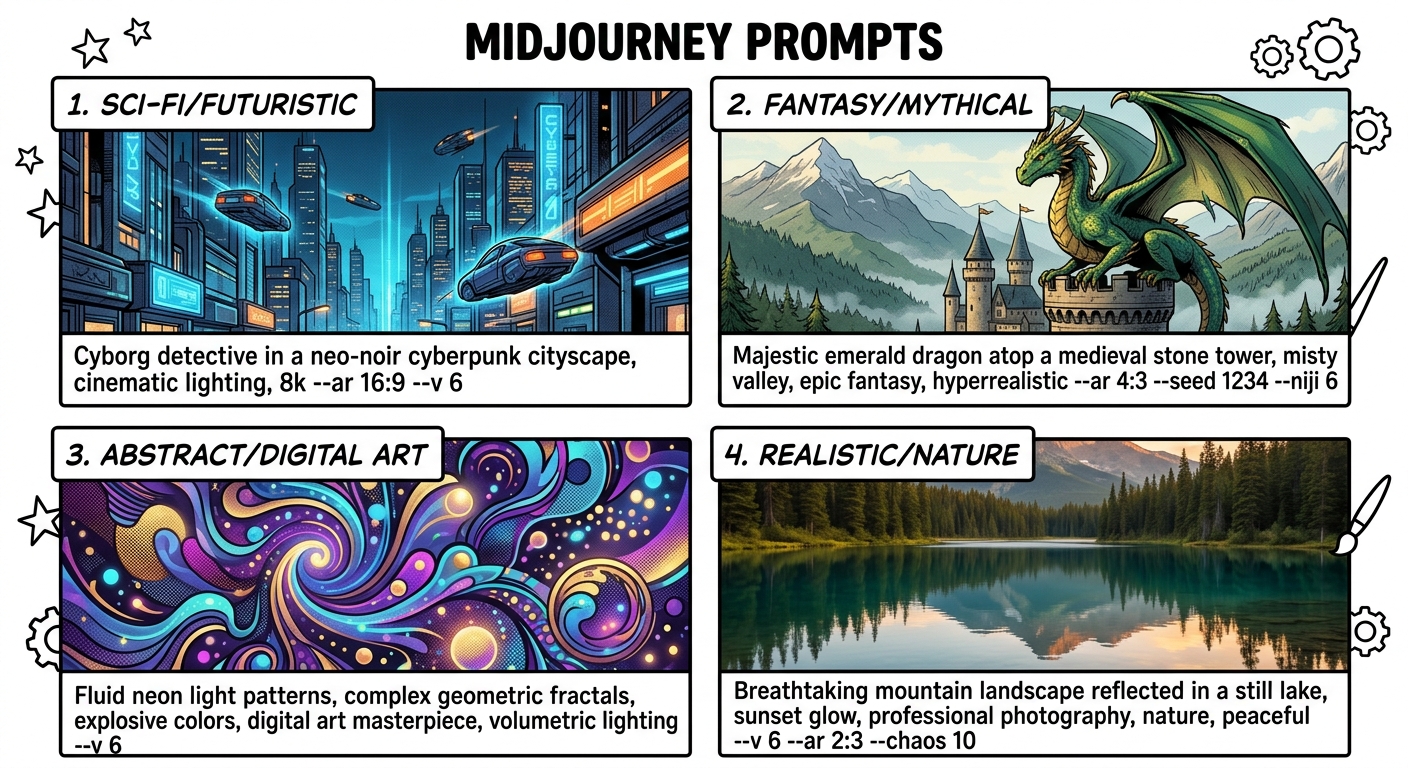
The best Midjourney prompts read like a short art brief: what’s in the picture, where it is, how it’s lit, and what style it’s in. That’s the whole formula. Below you’ll find the structure, the parameters worth learning, and 12 copy-paste prompts for common business and personal uses, with notes on why each one works.
The Structure That Works
Build every prompt in this order. You can skip parts, but keep the order, because words near the front tend to carry more weight.
- Subject. The main thing. “a golden retriever puppy”
- Details. What it’s doing or wearing. “sitting in a red wagon”
- Setting. Where. “on a suburban sidewalk in autumn”
- Light and mood. “late afternoon sun, warm and nostalgic”
- Style or medium. “35mm film photo” or “watercolor illustration” or “flat vector icon”
- Parameters. Settings at the end, like –ar 3:2
Put together: “a golden retriever puppy sitting in a red wagon, suburban sidewalk in autumn, late afternoon sun, warm and nostalgic, 35mm film photo –ar 3:2”
Notice what’s missing: filler words like “beautiful”, “stunning”, “8k masterpiece”. They add little. Concrete nouns and real photography or art terms do the work.
Parameters Worth Learning
Parameters go at the end of the prompt, each starting with two hyphens. You can also set many of them in the settings panel on the website. These are the ones you’ll use most:
- –ar sets the aspect ratio. –ar 16:9 for headers and slides, –ar 4:5 for social feeds, –ar 9:16 for stories.
- –no removes things. –no text, people, cars
- –s (stylize) sets how much artistic flair Midjourney adds. Lower follows your words more literally. Higher gets more dramatic.
- –c (chaos) makes the four grid results more different from each other. Useful when you’re exploring.
- –style raw gives a more literal, less polished look, good for realistic photos.
- –sref followed by an image link applies the style of a reference image. This is the key to a consistent look across a set.
- –seed with a number repeats the same starting noise, so small wording changes are easier to compare.
Parameter names and ranges can change between versions, so check the current documentation if one stops working.
12 Midjourney Prompts To Copy
For business
“a ceramic skincare jar on a travertine stone, soft shadow, beige and sage palette, minimalist product photo, studio light –ar 4:5 –style raw”
“a small team of four in a bright modern office, casual clothes, looking at a laptop together, candid documentary photo, natural window light –ar 16:9 –no logos, text”
“top-down flat lay of a bakery counter, sourdough loaves, flour dust, linen cloth, warm morning light –ar 1:1”
“simple flat vector icon of a house with a key, two colors, navy and coral, white background –no gradient, shadow”
“exterior of a 3-bedroom craftsman home at dusk, porch lights on, green lawn, real estate photo, wide angle –ar 3:2 –style raw”
Use generated property images only for concept or mood boards. Never present them as the real listing.
For content and social
“a cozy reading nook with a stack of books and a mug of tea, rainy window, moody editorial photo –ar 9:16”
“isometric illustration of a tiny home office, plants, laptop, pastel colors, clean lines –ar 16:9”
“close-up of hands kneading dough on a wooden board, flour in the air, shallow depth of field –ar 4:5”
“retro travel poster of a lighthouse on a rocky coast, bold flat shapes, limited color palette, 1960s print style –ar 2:3”
For personal projects
“children’s book illustration of a hedgehog in a knitted scarf walking through a snowy forest, soft gouache, gentle colors –ar 3:2”
“birthday party table set for a dinosaur theme, green and orange, balloons, playful styled photo –ar 16:9”
“watercolor map-style illustration of a small coastal town, pastel buildings, sailboats in the harbor –ar 3:2”
How To Fix Midjourney Prompts That Miss
When the result is off, diagnose before you rewrite. Match the problem to the fix:
- Wrong subject or the subject is lost: move it to the very start and cut extra details.
- Too artsy for a business use: lower –s and add –style raw.
- Unwanted objects: add them to –no instead of writing “without X” in the prompt. Words like “without” can pull the object in.
- Every result looks the same: raise –c or try a different style word.
- Wrong crop: set –ar first. Cropping later loses the composition.
- Garbled text: remove text from the prompt and add it later in a design tool, as covered in AI graphic design for beginners.
A worked example: you ask for “a coffee shop interior” and get dark, moody scenes when you wanted a bright café for a menu flyer. Add “bright, airy, white walls, morning light” after the subject, lower –s, and rerun. If it’s still too dim, add –no dark, shadows.
Change one thing per run. If you change the light, the style, and the ratio all at once, you won’t know which fix worked.
Build A Prompt Swipe File
Keep a simple document with three columns: the prompt, a thumbnail, and a note on what it’s good for. Tag each entry by use, such as product, social, or print. After a month you’ll have 20 to 30 tested prompts you can reuse by swapping the subject. The same habit works for text tools too. Our guide on how to write AI prompts shows how to structure a reusable prompt library.
Get Consistent Images Every Time
AI For Getting The Most From Midjourney includes a full prompt pack sorted by use, a parameter cheat sheet, and a worked example that builds a matching set of images for one brand. It’s written for people who want usable images without studying art theory first.