How AI Works: Prediction, Training, And Confident Mistakes
The short version
- A chat AI writes its answer one small piece at a time, each time picking a likely next word based on everything before it.
- It learned those patterns from a huge amount of text. It didn’t memorize a fact sheet, and it has no built-in way to check itself.
- It sounds equally sure when it’s right and when it’s wrong, because confident wording is simply the most common pattern in its training.
- So give it the facts it needs, ask for sources you can check, and verify anything that matters before you use it.
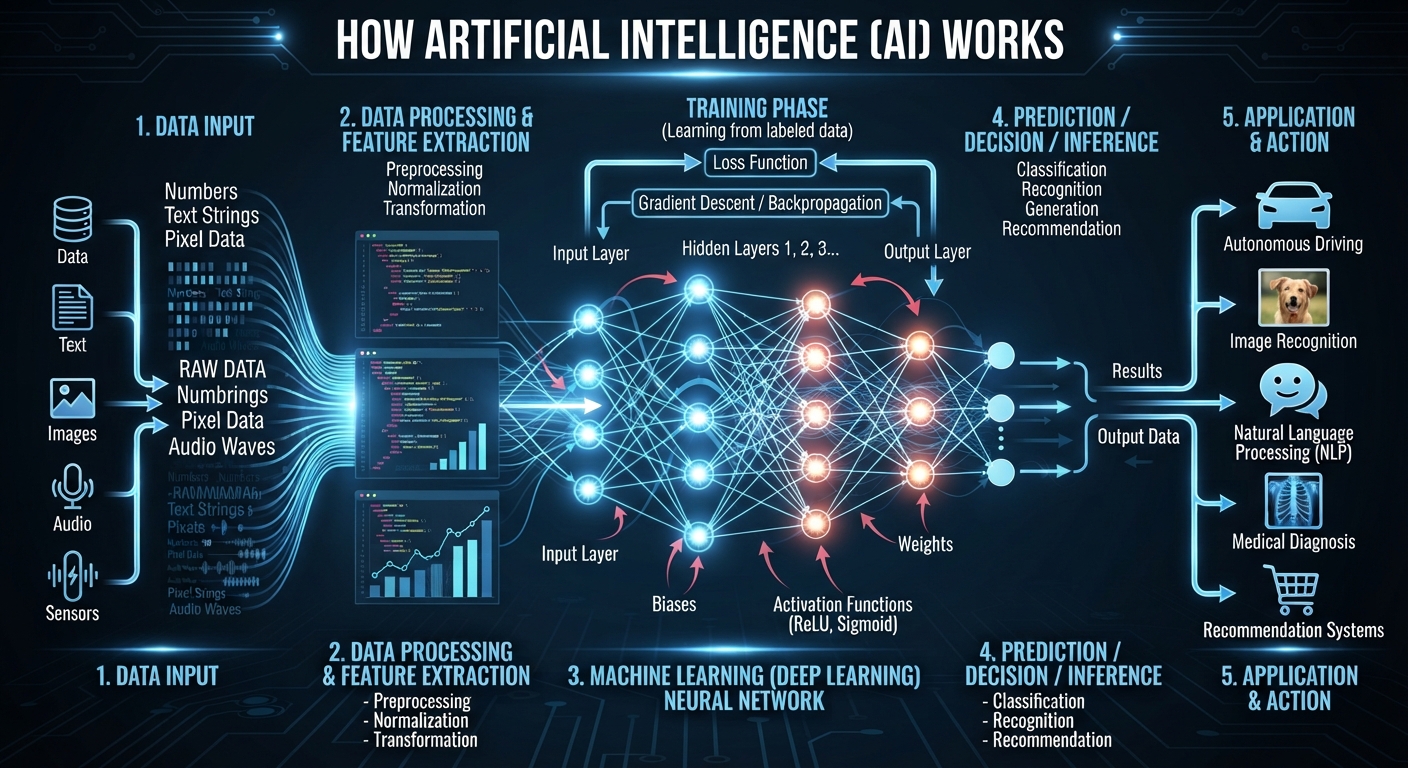
Here is how AI works in one line: a chat assistant predicts the next word, over and over, until it has an answer. Everything useful about it, and every mistake it makes, comes from that one fact.
You don’t need math to understand this. You need about five minutes and a few everyday comparisons. Once you have the picture, you’ll write better prompts and trust the output the right amount.
Prediction: The Engine Under The Hood
Think about your phone’s keyboard. You type “See you” and it suggests “soon” or “tomorrow.” It’s guessing the next word from patterns it has seen.
A chat AI does the same thing at a much larger scale. When you ask a question, it looks at your whole message and asks itself, in effect, “What piece of text most likely comes next?” It picks one, adds it, then asks again with that new piece included. It repeats this hundreds of times until the answer is done.
Those pieces are called tokens. A token is often a whole short word, sometimes part of a longer one. That’s why you’ll see limits described in tokens rather than words.
Two things follow from this:
- The AI isn’t looking anything up while it writes, unless the tool has a search feature switched on. It’s generating.
- Small changes in your prompt change what “likely next” means, which is why wording and context shift the answer so much.
Training Data: Where The Patterns Come From
Before you ever typed a word, the model was trained. Training means it was shown an enormous amount of text, such as books, websites, articles, and code, and adjusted itself again and again to get better at predicting the next word.
An analogy that helps: imagine someone who has read millions of recipes but never cooked. Ask for a banana bread recipe and they’ll give you a very good one, because they’ve seen thousands. Ask for the exact recipe from a small bakery in your town and they may invent one that sounds right, because they’ve seen the shape of a recipe but not that specific one.
That’s the model. It’s strong on things that show up often in writing and weak on rare, local, private, or very recent facts.
What training leaves out
- Anything that happened after its training ended, unless the tool can search the web.
- Your company’s files, your client list, your prices.
- Most local details, like who runs the hardware store on Main Street.
- Anything private or behind a paywall it never saw.
- The difference between a claim repeated online and a claim that’s true.
After the main training, companies do extra rounds where people rate answers and the model learns to be more helpful and polite. That’s why it sounds friendly. It doesn’t make it more factual on topics it barely saw.
Why It Sounds Sure When It’s Wrong
This is the part that trips people up. A model doesn’t have a separate gauge for “I know this” versus “I’m guessing.” It produces fluent, confident text either way, because most of the writing it learned from is fluent and confident.
So when it doesn’t know a fact, it doesn’t stop. It predicts what an answer would look like. You get a real-sounding book title with a fake author, a plausible statistic, or a court case that never existed. People call this a hallucination.
Back to the recipe reader. If they’ve read enough recipes, their made-up bakery recipe will look perfect: right format, right ingredients, right tone. Nothing in the writing signals that they invented it. The same goes for AI.
Newer tools are better at saying “I’m not sure” and some can search the web and show links. That helps a lot. It doesn’t remove the need to check. Our guide on how to spot AI mistakes lists the warning signs.
What How AI Works Means For How You Use It
Knowing the mechanics gives you a short set of habits that fix most problems.
- Give it the facts. Paste in the document, the numbers, or the notes. When the facts are in front of it, it rewrites and reasons instead of guessing. “Summarize this contract” beats “What are the usual terms in a contract like mine?”
- Give it context. Say who you are, who it’s for, and what good looks like. Every extra detail narrows what “likely next” means.
- Ask it to show its work. Request quotes, page numbers, or links you can open. If it can’t point to where something came from, treat it as a guess.
- Use it where patterns help. Drafting, rewording, summarizing, brainstorming, and explaining are all pattern work. It’s strong there.
- Check where facts matter. Names, numbers, dates, laws, prices, and medical or financial details. For legal, medical, or money questions, have a professional check the output before you act.
- Start fresh when it goes off track. A long chat carries its early mistakes forward, because everything before is part of what it predicts from.
A quick test to see this for yourself:
Give me three quotes about customer service, each with the person’s name and the book it came from.
Then search for each book yourself. You’ll often find at least one that’s shaky. Now try this instead:
Here’s our customer service policy. [paste policy] Pull out the three sentences that best explain our refund rules, word for word.
The second prompt gives it the facts, so it has nothing to invent. That’s how AI works best: as a fast writer and reader working from material you supply. For research tasks, our guide to research without hallucinations builds on exactly this idea.
The One Picture To Keep In Your Head
A very well-read assistant with no memory of where it read anything, who always answers in a confident voice. Hand it material and clear instructions, and it’s fast and useful. Ask it to recall rare facts from thin air, and check everything. Once you know how AI works at this level, you know enough to use it well.
Learn The Foundations The Practical Way
The Core Four Bundle turns these mechanics into daily habits: getting started, using AI on everyday tasks, researching and deciding without getting fooled, and prompting properly. Each book has a worked example, a prompt pack, and a cheat sheet.